At Semai Aviation, our participation at UMEX 2026 in Abu Dhabi wasn't just about showcasing our technology—it was about listening. Over the course of three days, our team engaged in more than 60 intensive meetings with a broad spectrum of industry leaders, including UAV manufacturers, R&D centers, motor and propeller developers, and drone service providers.
These conversations uncovered deep, systemic gaps in current industry testing and validation workflows. As uncrewed platforms take on increasingly critical operations, the market's feedback highlighted exactly why relying on guesswork is no longer an option.
Here are the key takeaways from the field:
1. The Reliability Gap: The Problem with OEM Datasheets
A striking 45% of the engineers we spoke with admitted that original equipment manufacturer (OEM) datasheets rarely reflect true motor and propeller performance under real-world operating conditions. Without independent, high-fidelity validation, design teams are frequently forced to over-engineer their propulsion systems simply to compensate for this data uncertainty.
2. Accelerating the Design Cycle
Time-to-market is everything, yet 52% of R&D teams agreed that their development cycles are heavily bottlenecked by a lack of immediate verification data. Engineering groups confirmed that integrating an agile, turnkey test stand into their laboratories would eliminate massive blocks of wasted time, cutting down design iterations significantly and allowing them to hit deployment targets on schedule.
3. The Hidden Cost of "DIY" In-House Rigs
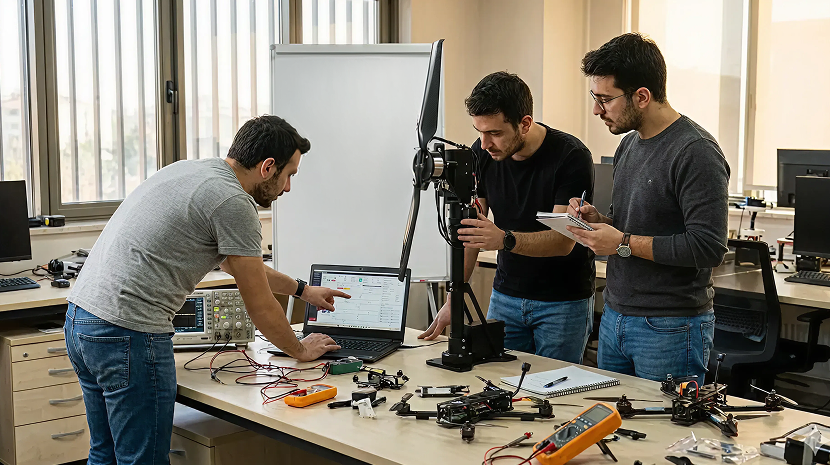
Building a custom test stand in-house often seems like a logical first step, and 12% of potential customers noted they initially attempted this route. However, the feedback was clear: ongoing load cell calibration issues, hardware maintenance, and software bugs quickly consumed valuable engineering hours. Teams ultimately realized that DIY approaches cost far more in lost time and compromised accuracy than investing in a professional, pre-calibrated testing solution.
4. Efficiency Demands & Fighting "Blind"
For 20% of UAV service providers, maximizing efficiency isn't just a preference—extending flight time by even a few minutes serves as a critical KPI for their business survival. Operators expressed that without precise, localized RPM curves and comprehensive efficiency analytics, they are effectively flying blind when trying to optimize their fleets for competitive commercial landscapes.
The New Industry Standard: Don't Guess. Validate.
As UAV missions scale in complexity and risk, the industry tolerance for error has dropped to zero. Modern aerospace engineering cannot depend on assumptions. Semai Aviation is proud to support the forward-thinking engineering teams choosing to eliminate uncertainty, streamline R&D, and validate their propulsion systems with the precision of the Dynotis ecosystem.